

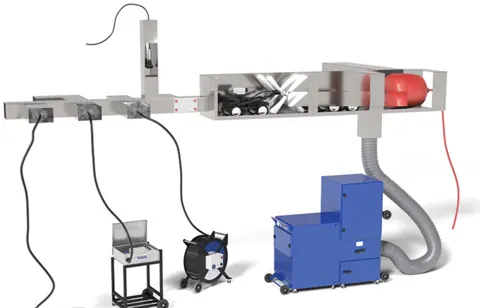
The machines come from Lamers Reinigingstechniek in Zelhem, in the Netherlands, a supplier of professional cleaning equipment: the Danduct Clean DC4, PD4, PD2 and the Intelligent Airnozzle, plus brushes, sealing products and extraction. Do you need to clean a ventilation system in a care facility, an office building, a food company, a commercial kitchen or a production hall? Here you can see which ventilation cleaning kit fits the job.
Are you a facility manager or a building owner? Then you will also find standards, guide values for frequency and costs here, so you know what you can expect from your cleaning contractor.

Air duct cleaning equipment from Lamers at a glance
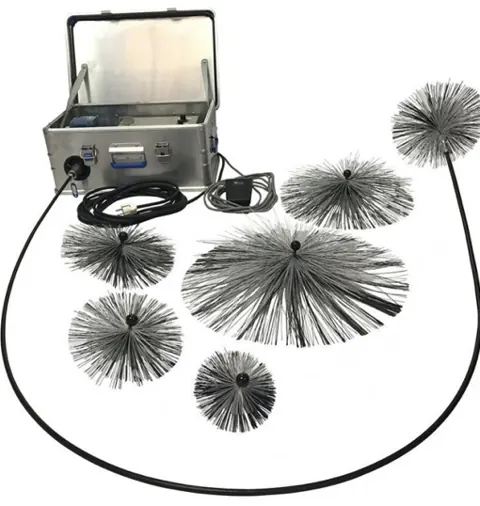 DC4 duct cleaning machineDC4: electric, up to 30 m, ducts from 100 to 600 mm
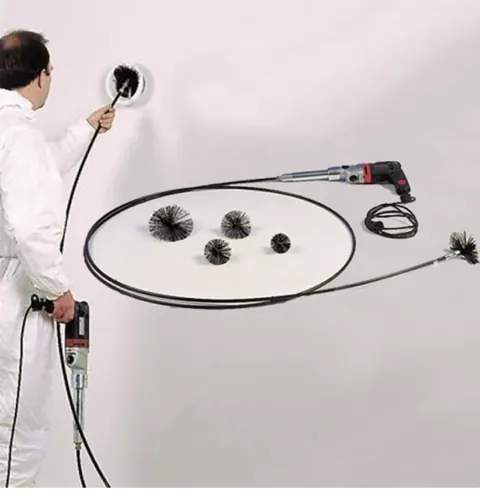 PD4 duct cleanerPD4: runs on a power drill, shaft 2.5 to 7.5 m
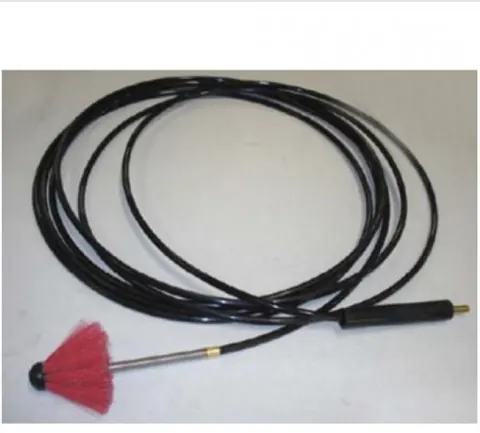 PD2 duct cleanerPD2: compact duct cleaner, specifications via Lamers
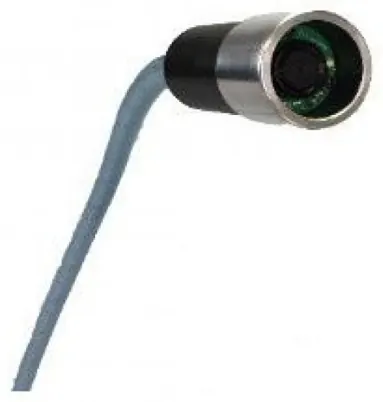 Intelligent AirnozzleCompressed air with camera, ducts from 30 mm
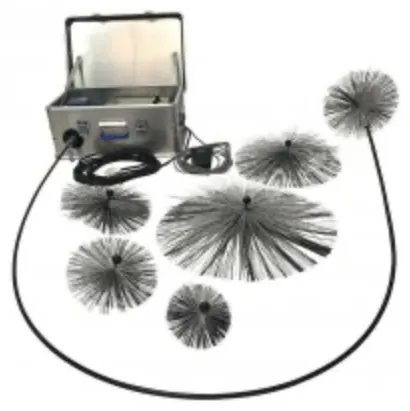 Duct cleaning brushesBrushes and shafts: soft, standard or Tynex
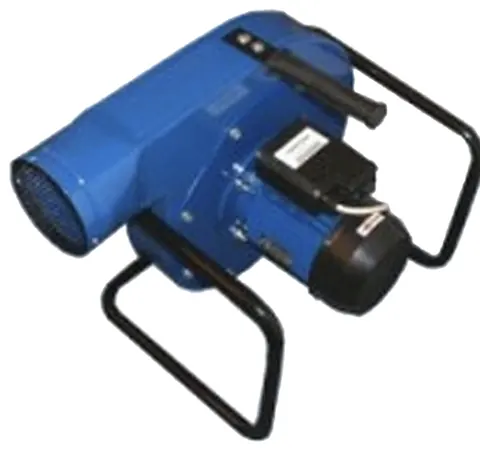 Duct sealing and extractionDuct balloons, diffuser caps and extraction
Ventilation duct cleaning for your clients: for cleaning contractors and installers
Most machines on this site are bought by companies that deliver ventilation cleaning as a service. A cleaning contractor or installer visits a care facility, an office or a commercial kitchen, inspects the ducts, cleans them and hands over a report. With many clients this happens in a fixed annual round: the ducts are checked every year and cleaned of dust straight away.
Note the difference between practice and obligation. There is no statutory cleaning frequency for ducts; KHN (Royal Dutch Hospitality Association) writes that it is not laid down in law for hospitality extraction, but that fire insurers do require regular maintenance. Insurers and advisers give guide values. The prevention conditions of the insurer Goudse ask hospitality businesses to have the exhaust duct and the motor inspected every year and, where necessary, cleaned by a specialist. Rabobank advises cleaning hospitality extract ducts professionally at least once a year.
| Client of the cleaning contractor | What is usually in the duct | What the client asks for |
|---|---|---|
| Care facility | Dust in supply and exhaust | Working under negative pressure, verifiable cleanliness |
| Office and school | Dust, sometimes construction dust after handover | Inspection report with photos |
| Food industry and bakery | Dust, flour, condensation | No spreading of dust, accessible filters |
| Hospitality and commercial kitchen | Grease | Report, photos and certificate for the insurer |
| Industry | Fine dust from process extraction | Performance restored, safe working |
How to set up such a service, which machine suits which type of client and how to report on the annual round is worked out in detail under air duct cleaning as a service.
Why a clean ventilation system pays off for your clients
A good story for your client starts with the why. Nobody sees a ventilation duct, and that is exactly why it is often forgotten. Yet every supply installation blows air through precisely those ducts into the workspace. The Dutch National Institute for Public Health and the Environment (RIVM) calls maintenance of the system and regular cleaning of filters and grilles important, and Milieu Centraal (Dutch public information centre) warns that moulds and bacteria can be blown along with the air when filters are dirty.
For your clients as employers there is a firm legal basis. Article 6.2 of the Working Conditions Decree (Arbobesluit) requires sufficient unpolluted air at the workplace (paragraph 1), an installation that is always ready for operation (paragraph 2) and a monitoring system that signals faults where this is needed for health (paragraph 4). A duct full of dust or grease fits poorly with that.
There is also a productivity argument: according to the World Green Building Council, better indoor air quality can increase productivity by 8 to 11 percent. And contamination slows the airflow. In a laboratory study of an MVHR unit (Energies, 2025), heavily contaminated filters gave 37 percent less supply air. That is mainly underventilation: you pay for an installation that does less than it can.
A practical tip for the conversation with your client: show photos from the duct before and after cleaning, refer to the article of the Working Conditions Decree and link the work to the annual inspection that is often already in the maintenance plan. That makes the value of the job visible to people who never look inside a duct.
Which duct cleaning equipment suits which duct?
The choice starts with three questions: what is the diameter, how long is the section you want to do in one go, and is there dry dust or sticky grease inside? The page on duct cleaning equipment has an extensive selection guide. Here is the overview to start with.
| Machine | Drive | Duct size | Reach | Typical use |
|---|---|---|---|---|
| Danduct Clean DC4 | Electric, 230 volt | 100 to 600 mm, round and square | Up to 30 metres | Long runs, vertical ducts, 90 degree bends |
| Danduct PD4 | Power drill (battery or mains) | Brushes 100 to 600 mm | Shaft of 2.5 to 7.5 metres | Short, small ducts |
| PD2 | Specifications via Lamers | Specifications via Lamers | Specifications via Lamers | Ask for advice on the application |
| Intelligent Airnozzle | Compressed air, around 10 bar, 700 L/min or more | From 30 mm | 20 m hose included | Small ducts, tight bends, with camera |
For long runs the DC4 duct cleaning machine is the logical first candidate: you feed the shaft into the duct and the machine does the rest. For short sections with your own drill, the PD4 duct cleaner is handy. For the PD2 duct cleaner, Lamers provides the specifications itself. And if you want to see what you are doing in narrow ducts, the Intelligent Airnozzle with built-in camera and LED lighting is interesting.
Commercial duct cleaning for clients in care, food, hospitality and industry
Every client of a cleaning contractor has a different kind of dirt and a different risk, and therefore needs a different set of equipment. That is why the site has detailed pages on air duct cleaning by sector. In short:
- Care: the Dutch guideline on air handling in operating theatres asks for an air management plan with technical management, maintenance and periodic checks. More on this under hospital ductwork cleaning.
- Food industry: the verification list of the Netherlands Food and Consumer Product Safety Authority (NVWA) asks to avoid airflows from contaminated to clean rooms and to keep filters accessible. See air hygiene in the food sector.
- Hospitality: according to KHN, grease in extract ducts is unhygienic and a serious fire risk. Find out everything about kitchen extract duct cleaning.
- Industry: fine dust and extraction close to the source call for robust machines. Have a look at industrial ductwork cleaning.
If you work in office buildings a lot, cleaning office ductwork explains what facility managers expect. Schools, hotels and bakeries each have their own page within the same hub, so you have the right arguments and equipment at hand for every client.
How often should ventilation ducts be cleaned and which standards apply?
There is no single statutory interval that applies to all buildings. Standards, insurers and knowledge institutes do give guide values. The full explanation is on the page about duct cleaning frequency.
| Situation | Guide value | Source |
|---|---|---|
| Hospitality extract duct | At least once a year professionally, twice a year for a fried food restaurant | Rabobank |
| Hospitality, legally | No statutory frequency, but insurers do require maintenance | KHN |
| Air handling with humidification | Hygiene inspection every 2 years | VDI 6022 |
| Air handling without humidification | Hygiene inspection every 3 years | VDI 6022 |
| Exhaust ducts of mechanical ventilation (home) | At least once every 8 years | Milieu Centraal |
The most important European standard is EN 15780:2025, which replaces the 2011 version. It sets cleanliness classes, inspection intervals per class and acceptable cleanliness levels, and now also covers kitchen extraction. How EN 15780 relates to the German hygiene guideline is explained in EN 15780 and VDI 6022.
Ductwork cleaning in five steps
Professional work almost always follows the same pattern. The detailed guide to air duct cleaning step by step goes deeper into each step.
- Inspect: a camera inspection and, where needed, swab samples show how dirty the duct is. KHN points out that serious contamination is often not visible to the naked eye.
- Seal: close valves and diffusers with foam caps, and seal duct sections with balloons.
- Create negative pressure: keep every section to be cleaned under continuous negative pressure, so that loosened dirt does not enter the room. If the extraction unit exhausts indoors, a HEPA filter of 99.97 percent at 0.3 µm is required. You arrange this with negative pressure with HEPA extraction.
- Clean: rotating brush, compressed air or a combination, depending on duct and dirt.
- Check and record: demonstrate the result with a surface comparison, a measurement or a photo report.
A simple checklist for the van: camera, foam caps in the common sizes, duct balloons, an extraction unit with the right filter, brushes for the materials you meet and a fixed report template. With that set, every job follows the same five steps.
Three misconceptions about air duct cleaning
"If the filters are clean, the ducts are too." Not necessarily. The US EPA describes how a lot of dust stays stuck to the duct wall. Replacing filters is maintenance; cleaning ducts is something else.
"Compressed air is always the fastest solution." In a bakery, Alimento and TNO actually advise against compressed air for cleaning, because of flour dust. And Lamers states honestly that an air nozzle was long found to be less effective than rotating brushes; only with a camera do you see and clean every spot and corner.
"You can always do it yourself." You can often clean grilles and valves yourself, but for the ducts themselves you need proper tools, sealing and extraction. The trade off is worked out under in house or outsourced duct cleaning.
Knowledge base: costs, rules and tips on air ducts
The air duct cleaning knowledge base brings all guides together: from mechanical ventilation and MVHR ducts to the standards and a step by step plan. Many visitors start with the question what duct cleaning costs. There you will find price indications from public sources, with the note that commercial cleaning is almost always tailor made after inspection.
Looking for information for a specific place in the Netherlands? Then the overview of ductwork cleaning per municipality helps, with figures from Statistics Netherlands (CBS) on the number of business establishments and the sectors that are most common there.
Why cleaning contractors request their duct cleaning equipment from Lamers
Lamers Reinigingstechniek is a family business that has supplied professional cleaning equipment for industrial cleaning and maintenance for more than 50 years, with standard solutions and customised machines. Besides duct cleaning machines, Lamers offers extraction and filtration equipment, accessories, sealing caps and built in air purifiers. As a cleaning contractor you can put your whole set together with one supplier. More background under the family business Lamers.
In doubt between two machines, or want to know which brushes fit your clients' ducts? Pass on the diameters, lengths, type of contamination and the client types you work for, and you can then request a quotation quickly. You can also request a callback, send a WhatsApp message or ask a question first.
Frequently asked questions: air duct cleaning
Who is this air duct cleaning website mainly intended for?
Mainly for specialist cleaning contractors, installers and facilities teams that buy equipment to clean the ducts of their clients in care, offices, food, hospitality and industry. Facility managers and building owners will find explanations of standards, frequency and costs, so they know what they can expect from their cleaning contractor.
Is air duct cleaning a legal obligation for employers in the Netherlands?
A fixed cleaning interval is not in the law. Article 6.2 of the Working Conditions Decree (Arbobesluit) does require sufficient unpolluted air at the workplace and a ventilation installation that is always ready for operation. A heavily contaminated duct makes it hard to meet that, so regular inspection and cleaning where needed is part of good building management.
Which Lamers machine should I choose for long air ducts?
For long runs the Danduct Clean DC4 is the most obvious choice. It cleans up to 30 metres deep in ducts of 100 to 600 mm, round and square, and can pass through vertical ducts and 90 degree bends. Lamers will help you choose shaft and brushes once you pass on the dimensions.
How often should the air ducts in a commercial building be cleaned?
That depends on use and sector. Rabobank advises cleaning hospitality extract ducts professionally at least once a year, and twice a year for a fried food restaurant. VDI 6022 names a hygiene inspection every 2 years for installations with humidification and every 3 years without. EN 15780:2025 links inspection intervals to cleanliness classes.
What does air duct cleaning cost for a business?
There is no fixed price. Cleaning contractors usually charge a tailor made price after inspection, depending on building type, length and number of ducts, contamination and accessibility. One provider quoted €150 to €350 per unit for smaller commercial premises and €450 to €950 for a camera inspection in April 2026. If you clean yourself, you request a quote for equipment.
Which standard applies to cleaning ventilation ducts in Europe?
The most important is EN 15780:2025, published in July 2025 as the successor to the 2011 version. The standard covers the cleanliness of ventilation systems over their whole life, for new and existing systems, including kitchen extraction. Industrial, medical and laboratory facilities are outside its scope. In Germany, VDI 6022 is also widely used.
Can a facilities team clean air ducts itself with its own equipment?
Yes, provided you have the right machine, brushes, sealing products and extraction. It is important that every section to be cleaned is under negative pressure and that you can demonstrate the cleanliness afterwards. For care and the food industry, sources advise separating cleaning from the hygiene inspection, so the assessment stays objective.
Why is grease in a restaurant extract duct so dangerous?
Grease sticks to the inside of the duct and, according to KHN, can catch fire during flambéing or a pan fire. Rabobank calls the kitchen the place where most hospitality fires start and the extraction installation a major culprit. Insurers therefore require regular maintenance, even though the frequency is not fixed by law.
Is compressed air or a rotating brush better for air duct cleaning?
That depends on the duct. A rotating brush works mechanically and is strong in ducts of 100 to 600 mm. Compressed air, such as the Intelligent Airnozzle, reaches ducts from 30 mm and gets through tight bends, and with the built-in camera you see where you are cleaning. Often the combination works best.
How do I ask Lamers for advice on air duct cleaning equipment?
Give Lamers the diameters and shapes of your ducts, the length of the runs, the number of bends and the type of contamination. With that information Lamers can advise which machine, shaft and brushes fit. You can request a quote, request a callback, send a WhatsApp message or ask a question first.
Sources and reference date
All facts on this page were checked on 6 October 2026.
- Lamers Reinigingstechniek (in Dutch)
- Lamers: DC4 duct cleaner (in Dutch)
- Working Conditions Decree (Arbobesluit) article 6.2 (in Dutch)
- NS-EN 15780:2025
- KHN: odour nuisance, fire hazard and wood burning ban (in Dutch)
- Rabobank: fire safety in hospitality (in Dutch)
- TÜV SÜD: VDI 6022 hygiene inspections (in German)
- World Green Building Council
- Goudse: prevention conditions for commercial premises and hospitality (in Dutch)
Editorial team: Lamers Reinigingstechniek B.V., supplier of professional air duct cleaning equipment in Zelhem, the Netherlands. Updated on . See also about Lamers Reinigingstechniek.
Request a quote or advice from Lamers

René Hendriksen, Sales Account Manager at Lamers, advises you on the machine, brushes and extraction for your jobs.
Briefly tell us what you clean (duct type, diameter, length, contamination and sector). Lamers will contact you with advice and a tailored quote.
Prefer direct contact? Call +31 (0)314 623 341, message us on WhatsApp 06-38048347 or email info@lamersequipment.nl.
Prefer a quick call first? Lamers will call you back
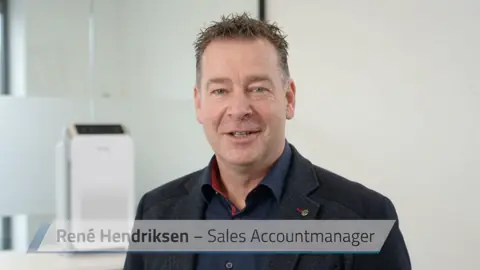
Leave your number. René Hendriksen or a colleague from Lamers will call you back to discuss duct type, diameter and the right equipment.
Or send us a message right away: WhatsApp 06-38048347