

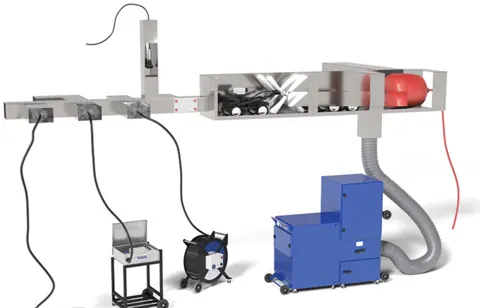
On this overview page you can see, per sector, what the biggest risk is, which rule or guideline counts and which type of equipment usually fits. For each sector there is then a dedicated guide with more depth, practical tips and the questions facilities teams, facility managers and cleaning contractors often have. Lamers Reinigingstechniek in Zelhem, the Netherlands, supplies the Danduct Clean machines and accessories; the guides help you choose.

Choose your sector
- Air duct cleaning hospitalsAir duct cleaning in hospitals: air management plan, VDI 6022, the operating theatre guideline and the equipment your technical service needs.
- Air duct cleaning care homesAir duct cleaning in nursing and care homes: rooms, corridors and kitchens, legionella in humidification and planning without disruption. With tips.
- Air duct cleaning officesAir duct cleaning in offices: Arbobesluit, indoor climate, productivity and planning outside working hours. Which equipment suits office ductwork?
- Air duct cleaning schoolsAir duct cleaning in schools: Frisse Scholen, CO2 meters in every classroom, construction dust after handover and maintenance during school holidays.
- Air duct cleaning food industryAir duct cleaning in the food industry: airflow from dirty to clean zones, condensation, filters and hygiene audits. Tips and equipment for food plants.
- Air duct cleaning bakeriesAir duct cleaning in bakeries: flour dust, the 0.2 mg/m3 advice, no compressed air in dusty zones and ATEX vacuum cleaners. A practical guide for bakers.
- Kitchen extract duct cleaningKitchen extract duct cleaning in hospitality: grease build up, fire risk, insurer requirements and the NVRL quality mark. How often and with which kit?
- Air duct cleaning industryAir duct cleaning in industry: dust, oil mist, explosion risk and extraction systems. Industrial cleaning with the right equipment and careful planning.
- Air duct cleaning hotelsAir duct cleaning in hotels: guest rooms, bathroom extraction and kitchens, planned floor by floor without disturbing guests. Tips and suitable kit.
- Air duct cleaning for contractorsOffering air duct cleaning as a cleaning contractor or installer? How to choose equipment per job, from residential ducts to industrial ductwork.
Why air duct cleaning by sector works out differently
An air duct is a tube with air in it everywhere, but what ends up inside differs per building. Supply ducts in an office mainly collect fine dust and fibres. An extract duct above a deep fryer builds up a grease layer that can ignite. In a bakery flour dust settles, and in industry it is process dust or oil mist. That determines three choices: how often you inspect, which method you use (dry or wet, brush or compressed air) and how you prove the result is good.
Regulation also plays a role. The rules of the Working Conditions Decree (Arbobesluit) on ventilation (article 6.2) apply to every workplace, but care institutions have extra guidelines for infection prevention, hospitality businesses get conditions from their fire insurer and schools work with the Frisse Scholen (Fresh Schools) programme of requirements. Knowing the sector requirements prevents cleaning too little or unnecessarily often.
Overview: ventilation duct cleaning in different sectors side by side
The table below gives, per sector, the main risk, a leading document and the equipment that usually fits. It is a first decision aid; the details are on the sector pages.
| Sector | Biggest risk | Leading document | Suitable equipment |
|---|---|---|---|
| Hospitals | Infection prevention, operating theatre air | Guideline on air handling in operating theatres, air management plan | Camera inspection, brushing machine, negative pressure |
| Nursing and care homes | Vulnerable residents, kitchen grease | SRI guidelines, NVRL quality mark for kitchens | Compact brush, compressed air, sealing caps |
| Offices | Indoor climate, absenteeism | Arbobesluit art. 6.2 | Brushing machine for main ducts |
| Schools | CO2, construction dust after handover | Frisse Scholen programme of requirements | Brushing machine, compact cleaner per classroom |
| Food industry | Cross contamination, condensation | NVWA verification list, BRCGS | Brush plus HEPA extraction |
| Bakeries | Flour dust, dust explosion | TNO memo for the bakery sector | Brush with vacuum cleaner, no compressed air |
| Hospitality | Grease fire | KHN, insurer conditions | Inspection, wet method, grease measurement |
| Industry | Process dust, ATEX | Arbobesluit, ATEX | Robust brushing machine, extraction |
| Hotels | Bathroom extraction per room | Arbobesluit, Bbl | Small ducts, drill driven cleaner |
Healthcare: hospitals and elderly care require extra hygiene
In healthcare, air is part of patient safety. Operating theatres fall under a guideline that makes an air management plan mandatory, and for infection prevention the SRI is the successor to the WIP guidelines. See how facilities teams handle that under air duct cleaning in hospitals. For long term care, with many small rooms, bathrooms and a large kitchen, there is a separate guide on ventilation in elderly care.
Offices, schools and hotels: a healthy indoor climate as the goal
In commercial and public buildings it is less about acute hazards and more about comfort, health and energy. Dirty filters and ducts deliver less air and more complaints. Facility managers will find practical planning and requirements under air duct cleaning in offices. School boards and accommodation advisers can find everything about CO2 monitors, construction dust and holiday planning under ventilation ducts in school buildings. Hotels, by contrast, have many short ducts per room; that is covered on the page about bathroom extraction in hotels.
Food, bakery, hospitality and industry: grease, flour and process dust
Where products are made or food is cooked, contamination is heavier and sometimes combustible. In the food sector, airflows from dirty to clean and easily accessible filters are central; see air hygiene in the food sector. Bakers work with flour dust that you should not blow away with compressed air: more on that under air duct cleaning in bakeries. In restaurant kitchens grease is the big culprit, worked out on the page on kitchen extract cleaning. And for production halls with process extraction there is a guide on extraction ducts in factories.
Cleaning contractors and installers: ductwork cleaning for businesses as a service
Many organisations outsource the work. If you are the company cleaning the ducts, you want equipment that can be used in all these sectors: from small bathroom ducts to 600 mm main ducts. On the page with duct cleaning business you can see how to put together a machine fleet. If you would like to see the options side by side first, compare all compare duct cleaning kits for cleaning contractors by diameter, reach and drive.
How do you choose the right approach for your sector?
Start with three questions. What is in your ducts: dry dust, grease, flour or something else? Which rules or insurance conditions apply to your building? And how large and accessible are the ducts? With those answers you choose a method and the matching machine, brushes and sealing materials.
- Have the ducts inspected, preferably with a camera, so you know how dirty they really are.
- Record which standard or guideline you use as a benchmark.
- Choose dry or wet cleaning and the matching equipment.
- Record the result with photos or measurements for your file or insurer.
Not sure which machine suits your sector? Duct cleaning equipment quote to ask a question or request a quote.
Frequently asked questions: commercial air duct cleaning
Does commercial air duct cleaning really differ that much by sector?
Yes. The type of contamination determines the method. Dry dust in an office is removed with a rotating brush and extraction, grease in a restaurant duct usually needs a wet method and flour dust in a bakery should not be blown away with compressed air. The rules differ too: healthcare has infection prevention guidelines, hospitality gets insurer requirements and schools work with Frisse Scholen.
Which sector has the strictest requirements for clean air ducts?
Healthcare, and operating theatres in particular. There the guideline on air handling requires an air management plan with technical management, maintenance and periodic checks, and class 1 and 2 theatres must have signalling that shows whether the air handling works properly. In hospitality the requirements focus mainly on fire safety and come from fire insurers.
Does the Dutch Working Conditions Decree apply to air ducts in every sector?
Article 6.2 of the Arbobesluit applies to every workplace. There must be enough uncontaminated air and a ventilation installation must be in working order at all times. The article gives no cleaning frequency, but dirty ducts and filters make it harder to meet those requirements. Sector specific rules come on top of that.
Can I use the same duct cleaning machine in every sector?
Often yes, provided you adapt the brushes and accessories. A machine for ducts from 100 to 600 mm covers many offices, schools and care buildings. For very small or winding ducts, a compact cleaner or compressed air nozzle is handier. For grease in kitchen ducts you often choose a wet method, and in bakeries you work with extraction instead of compressed air.
Which sectors need to measure grease contamination in ducts?
Mainly hospitality and large kitchens in hospitals, care homes and offices. The NVRL and TNO quality mark scheme focuses on grease contamination in kitchen extraction and uses an intervention value of 500 µm and no more than 200 µm after cleaning. Measurement is done with a wet film thickness gauge behind each hood and per 10 metres of duct.
Is there a statutory cleaning frequency for each sector in the Netherlands?
No, not for most sectors. For hospitality extract ducts, KHN states that the frequency is not set by law, although fire insurers do require regular maintenance. In other sectors the frequency follows from inspection, standards such as EN 15780 and guidelines such as VDI 6022, which specifies hygiene inspections every 2 or 3 years.
Why is compressed air duct cleaning not suitable for every sector?
Compressed air loosens dirt and moves it. With good negative pressure and extraction that is manageable, but in bakeries cleaning with compressed air is advised against because flour dust then swirls up. There, an industrial vacuum cleaner with the right filter is the safer choice. In small ducts with many bends, compressed air with a camera is in fact a strong option.
Which sector guide fits a staff restaurant inside an office building?
For the office ducts themselves, use the offices guide. For the extraction above the cooking equipment of the staff restaurant, the same points apply as in hospitality: grease build up, fire risk and demonstrable maintenance for the insurer. So combine both guides and distinguish between supply, general extract and kitchen extraction.
Can a cleaning contractor serve all sectors with one machine fleet?
A basic set gets you a long way: a brushing machine for medium sized ducts, a compact cleaner for small ducts, brushes in different stiffnesses, sealing balloons and HEPA extraction. Anyone who also wants to serve hospitality or the process industry additionally needs equipment for wet cleaning and measuring tools. Ask for advice on a combination that suits your clients.
How do I find the right duct cleaning guide for my type of building?
Look at the main use of your building and the type of contamination. A care building with resident rooms fits the guide for nursing and care homes, a building with operating theatres fits the hospital guide. If you have several functions under one roof, read the matching guide per function and draw up a separate plan for each part of the installation.
Sources and reference date
All facts on this page were checked on 6 October 2026.
- Working Conditions Decree (Arbobesluit) article 6.2 on ventilation (in Dutch)
- Guideline: air management plan for operating theatres (in Dutch)
- KHN: must the extract duct be cleaned? (in Dutch)
- NVRL/TNO quality mark scheme for cleanliness (in Dutch)
- TNO memo on vacuum cleaners in the bakery sector (in Dutch)
- RVO Frisse Scholen process manual (in Dutch)
- TÜV SÜD: VDI 6022 hygiene inspections (in German)
Editorial team: Lamers Reinigingstechniek B.V., supplier of professional air duct cleaning equipment in Zelhem, the Netherlands. Updated on . See also Lamers Equipment for cleaning contractors.
Request a quote or advice from Lamers

René Hendriksen, Sales Account Manager at Lamers, advises you on the machine, brushes and extraction for your jobs.
Briefly tell us what you clean (duct type, diameter, length, contamination and sector). Lamers will contact you with advice and a tailored quote.
Prefer direct contact? Call +31 (0)314 623 341, message us on WhatsApp 06-38048347 or email info@lamersequipment.nl.
Prefer a quick call first? Lamers will call you back

Leave your number. René Hendriksen or a colleague from Lamers will call you back to discuss duct type, diameter and the right equipment.
Or send us a message right away: WhatsApp 06-38048347