

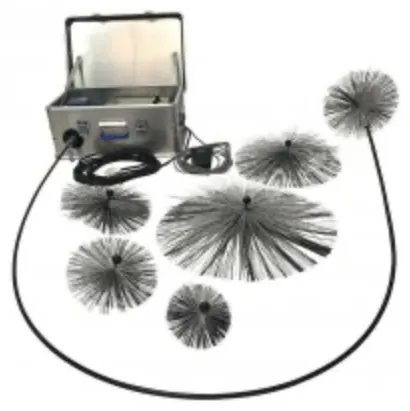
Danduct Clean, whose machines are supplied by Lamers Reinigingstechniek, works with soft, standard and more aggressive Tynex brushes in sizes from 100 to 600 mm. On this page you can see which brush belongs with which duct, how to determine the size, which shaft you need and which mistakes are best avoided.

Why does a rotating brush work so well in air ducts?
Dust does not just lie loose in a duct. The US EPA points out that a lot of dust stays stuck to the wall. A rotating brush loosens it mechanically, while an extraction unit removes the loosened dust under negative pressure. That is the classic combination used by cleaning contractors, alongside compressed air, robots with cameras and manual work.
The big advantage of a brush is force on the wall. With larger cross sections and dirt that is stuck, a spinning brush removes more than air alone. The drawback: a brush starts at a certain minimum size. For very thin ducts, compressed air duct cleaning is often the better choice.
Which duct brush do you choose: soft, standard or Tynex?
You match the stiffness of the brush to the duct material and the type of dirt. Danduct Clean supplies three types.
| Brush type | Suitable for | Less suitable for |
|---|---|---|
| Soft | Fibreglass duct board, thin walled sheet steel, fragile walls | Stubborn, caked on deposits |
| Standard | Routine maintenance of steel ducts with dry dust | Fragile duct board |
| Tynex (more aggressive) | Heavy contamination on sturdy steel walls | Soft or damaged walls, flexible duct |
Source: Danduct Clean, shaft brushes, and the US EPA, checked on 6 October 2026. The EPA recommends soft brushes for fibreglass duct board and for sheet steel. So when in doubt, start soft and only step up if the dirt will not come loose.
For the Danduct Clean DC4 duct cleaner, Lamers lists polypropylene brushes with bristles of 0.6 and 0.9 mm. The larger package contains an aggressive set of seven pieces in addition to the standard brush set.
How do you determine the right size of ventilation duct brush?
The brush must touch the wall all round. If it is too small, it spins through the middle and the dust stays on the wall. If it is too large, it runs heavily and can get stuck in a bend. This is how to approach it:
- Measure the internal size. For round ducts the diameter, for rectangular ducts the width and height.
- Look for reducers. A run that goes from large to small requires several brushes or several passes.
- Choose the set. The DC4 brush sets consist of seven brushes from 100 to 600 mm, so you can change per run.
- Test on a straight section. Check that the brush makes even contact before you go into a bend.
If you work with rectangular ducts, Lamers states that the DC4 can handle both round and square ducts. Discuss the ratio between width and height with Lamers, because a round brush in a flat duct does not reach everywhere.
Which shaft goes with your air duct brush?
The shaft carries the brush to the dirt and keeps it on course. The length determines how far you can get from an opening, the stiffness how well you get through bends.
| Machine | Shaft length | Brush sizes | Drive |
|---|---|---|---|
| DC4 | 10, 20 and 30 m (Large package) | 100 to 600 mm | own motor, 230 volts |
| PD4 | 2.5 to 7.5 m | 100 to 600 mm, available separately | power drill |
| PD5 (for comparison) | 3 to 15 m | ducts of 80 to 250 mm | power drill |
Source: Lamers and Danduct Clean, checked on 6 October 2026. Danduct mentions soft shafts for small ducts with bends. On the DC4, a light solid steel shaft keeps the brush in the centre of the duct, which helps it touch the wall evenly. For short sections, the compact PD4 duct cleaner is a handy option. For the specifications of the PD2 from Lamers, ask Lamers.
Also important: the distance between openings. A Eurovent recommendation mentions inspection openings no more than 10 metres apart, or after no more than two bends of 45 degrees or more. Ducts larger than 500 mm need an access panel of at least 500 by 400 mm.
How do you take a duct brush through bends and vertical sections?
Bends are where dust accumulates and where brushes get stuck. According to Lamers, the DC4 is designed for vertical ducts and 90 degree bends. A few practical tips:
- Let the machine do the work and do not push hard through a bend. A shaft that kinks loses contact with the wall.
- Use the automatic left to right system of the DC4, which you set on a timer. Ask Lamers which setting suits your run.
- Adjust the speed. The DC4 has adjustable speed: lower in bends, higher on straight sections.
- On vertical sections, work from top to bottom where possible, so that loose dirt falls towards the extraction.
If you come across bends that are too tight for a brush, a compressed air nozzle with a camera is a useful addition. See also the overview of tools for cleaning air ducts.
Brushing alone or with a spray system and extraction?
According to a Eurovent recommendation, dry brushing is usually sufficient for supply ducts and general extract ducts. Extract ducts from commercial kitchens require wet methods, because grease does not come loose like dust. A spray system exists for the DC4, the DC4 Sprayer System. What exactly you can do with it is something to discuss with Lamers.
With greasy kitchen extraction the insurer also plays a role. An insurer such as Goudse requires fixed, non flexible and non corrugated ductwork of aluminium or steel in hospitality. More on this on the page about removing grease from kitchen extraction.
Either way: without extraction, brushed off dust goes into the room or the system. The EPA mentions exhausting through a HEPA filter or to the outside. How to set that up is explained under duct sealing and extraction.
Common mistakes when choosing an air duct brush
Starting too hard. A Tynex brush on duct board or a thin walled duct can damage the inside. Start soft.
One size for everything. Buildings have reducers. With a set of seven sizes you can change per run.
No check afterwards. A brush without a camera does not show what is left behind. Combine it with inspection, especially at bends.
Brushing without a plan. Know beforehand which runs you will do and in what order. A step by step plan helps: see the duct cleaning method.
Fictional example: a facilities team uses one large brush for a run that narrows from 400 to 200 mm. The wide section gets clean, the narrow section does not, and the brush gets stuck in the reducer. With two sizes and an opening at the reducer, it would have gone right the first time.
Quick checklist before you start brushing
- Internal size of every run measured and noted.
- Duct material known, so the stiffness matches the wall.
- Shaft length checked against the distance between openings.
- Extraction connected and the section under negative pressure.
- Camera or inspection planned for bends and reducers.
Air duct cleaning equipment from Lamers at a glance
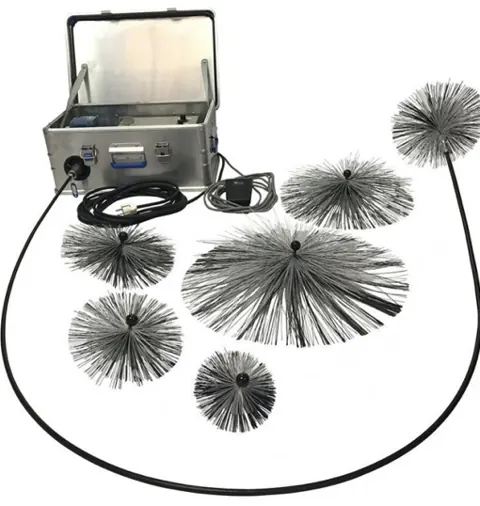 DC4 duct cleaning machineDC4: electric, up to 30 m, ducts from 100 to 600 mm
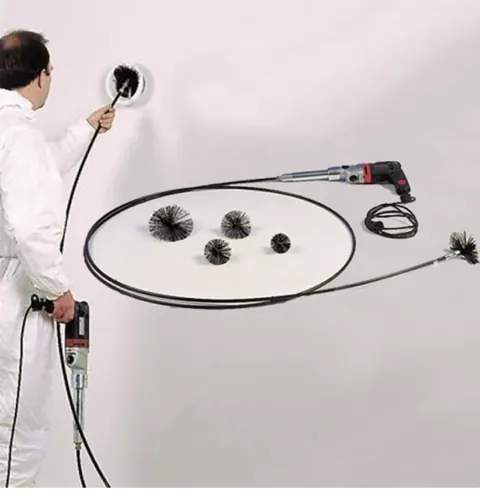 PD4 duct cleanerPD4: runs on a power drill, shaft 2.5 to 7.5 m
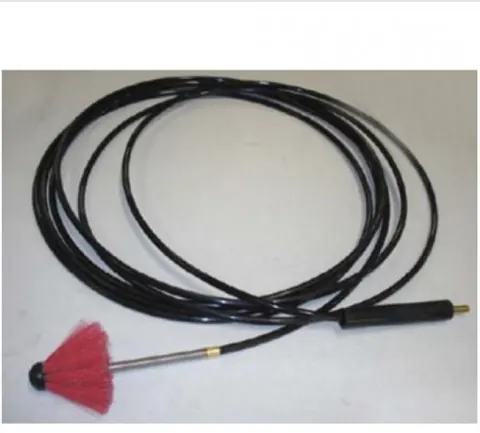 PD2 duct cleanerPD2: compact duct cleaner, specifications via Lamers
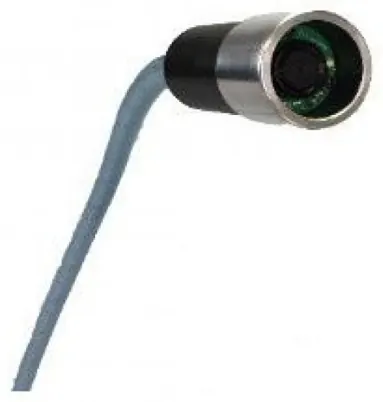 Intelligent AirnozzleCompressed air with camera, ducts from 30 mm
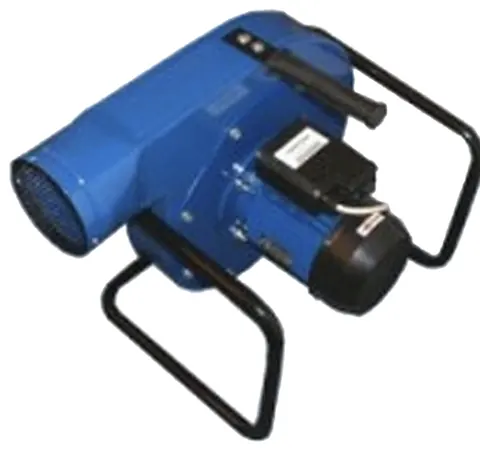 Duct sealing and extractionDuct balloons, diffuser caps and extraction
Frequently asked questions: duct cleaning brushes
Which duct cleaning brush should I use in fibreglass duct board?
Use a soft brush. The US EPA recommends soft brushes for fibreglass duct board and for sheet steel, so that the inner wall is not damaged. Danduct Clean supplies soft, standard and more aggressive Tynex brushes, so you can choose the right stiffness for each duct material.
What is a Tynex brush for air ducts?
At Danduct Clean, Tynex is the more aggressive brush type, alongside soft and standard. You use it for heavy contamination on sturdy steel walls. It is not recommended on fragile ducts or flexible duct, because it can damage the wall. When in doubt, try a softer brush first and only switch if the dirt stays put.
Which brush sizes are included in the DC4 brush set?
According to Danduct Clean, the DC4 brush set consists of seven brushes from 100 to 600 mm. The Large package also contains an aggressive set of seven pieces. Lamers lists polypropylene brushes with bristles of 0.6 and 0.9 mm, so you can match both size and stiffness to the duct.
How do I know whether my duct brush has the right diameter?
Measure the internal size of the duct and choose a brush that touches the wall all round. First test on a straight section whether the brush makes even contact. Too small leaves dust behind, too large runs heavily and can get stuck in a bend.
Can I also clean rectangular ducts with an air duct brush?
Yes, according to Lamers the DC4 is suitable for round and square ducts. In rectangular ducts with a large ratio between width and height, a round brush does not reach everywhere. So discuss the dimensions with Lamers beforehand to choose the right brush.
How long should the shaft of my duct cleaning brush be?
The shaft length depends on the distance between openings. The DC4 reaches up to 30 metres, the PD4 has a shaft of 2.5 to 7.5 metres. A Eurovent recommendation mentions inspection openings no more than 10 metres apart or after two bends of 45 degrees or more. Measure the run first, then choose the shaft.
Can I order brushes for the PD4 duct cleaner separately?
Yes. Danduct Clean states that the 100 to 600 mm brushes for the PD4 are available separately. That way you can put together a set that matches the ducts you come across most often. Ask Lamers which sizes and stiffness grades are the best choice for your work.
Is dry brushing enough for a greasy kitchen extract duct?
Usually not. According to a Eurovent recommendation, dry methods are sufficient for supply and general extract ducts, but extract ducts from commercial kitchens require wet methods. A spray system exists for the DC4. Discuss with Lamers what suits your kitchen ducts and how the spray system fits into your work.
Why does my brush get stuck in a bend of the ventilation duct?
Often the brush is too large for the bend or you are pushing too hard. Choose a suitable size and reduce the speed in bends. The DC4 has adjustable speed and an automatic left to right system that you set on a timer, and it is designed for 90 degree bends.
Do I need extraction when I clean an air duct with a brush?
Yes. The brush loosens the adhering dust, but without extraction it goes into the room or the system. Put the duct section under negative pressure and exhaust the air through a HEPA filter or to the outside, as the EPA advises. Seal off neighbouring openings so the dust stays where your extraction can reach it.
Sources and reference date
All facts on this page were checked on 6 October 2026.
Editorial team: Lamers Reinigingstechniek B.V., supplier of professional air duct cleaning equipment in Zelhem, the Netherlands. Updated on . See also the family business Lamers.
Request a quote or advice from Lamers

René Hendriksen, Sales Account Manager at Lamers, advises you on the machine, brushes and extraction for your jobs.
Briefly tell us what you clean (duct type, diameter, length, contamination and sector). Lamers will contact you with advice and a tailored quote.
Prefer direct contact? Call +31 (0)314 623 341, message us on WhatsApp 06-38048347 or email info@lamersequipment.nl.
Prefer a quick call first? Lamers will call you back

Leave your number. René Hendriksen or a colleague from Lamers will call you back to discuss duct type, diameter and the right equipment.
Or send us a message right away: WhatsApp 06-38048347